Origins
A people of the desert trade
The Nabataeans were originally a nomadic people of north-western Arabia, and for most of their early history they left almost nothing built behind them. What made them powerful was not territory but knowledge: they knew the desert routes, they knew where every hidden water source lay, and they controlled the caravan traffic in frankincense, myrrh and spices moving north from Arabia toward the Mediterranean markets of Gaza, Damascus and the Levant.
By the late fourth century BC the Nabataeans were using the natural strongholds of the Petra basin as a base and a refuge. The valley is entered through narrow gorges — most famously the Siq — that made it easy to defend and almost impossible to find unless you already knew the way. For a caravan people who valued secrecy, it was perfect.
From camp to capital
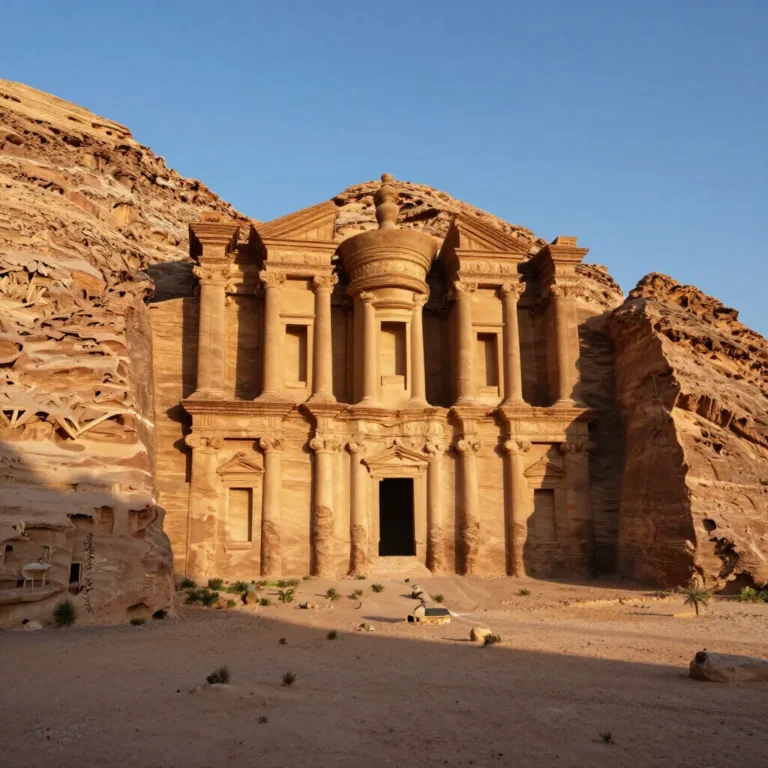
Through the second and first centuries BC the Nabataeans transformed Petra from a seasonal refuge into a genuine capital. Wealth poured in from the caravan trade, and they spent it on a city carved directly into the sandstone cliffs — tombs for their elite, temples, a theatre, and a sophisticated water system that could sustain a population estimated at around twenty thousand at its peak. That is larger than many Roman cities of the same period.
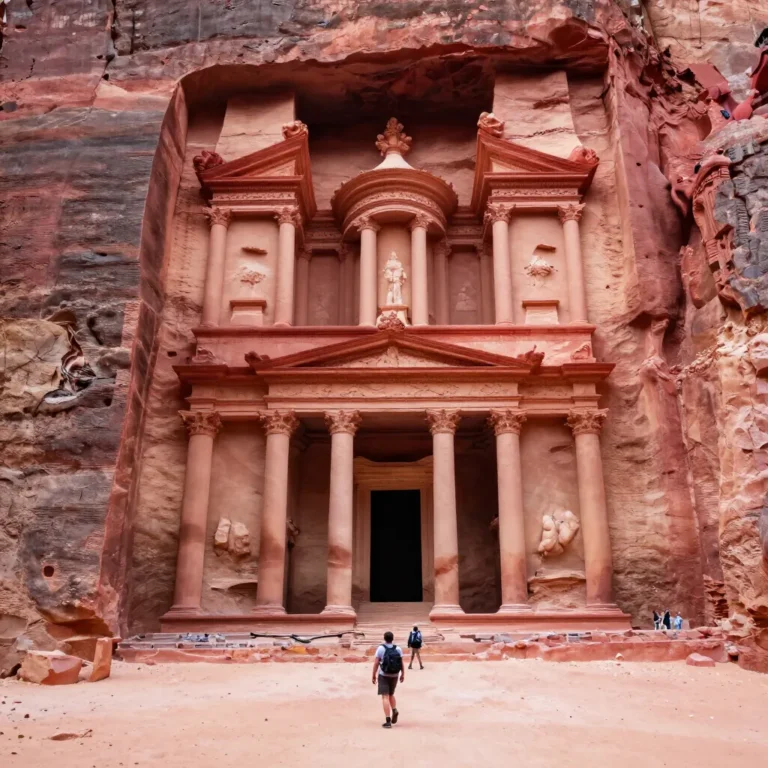
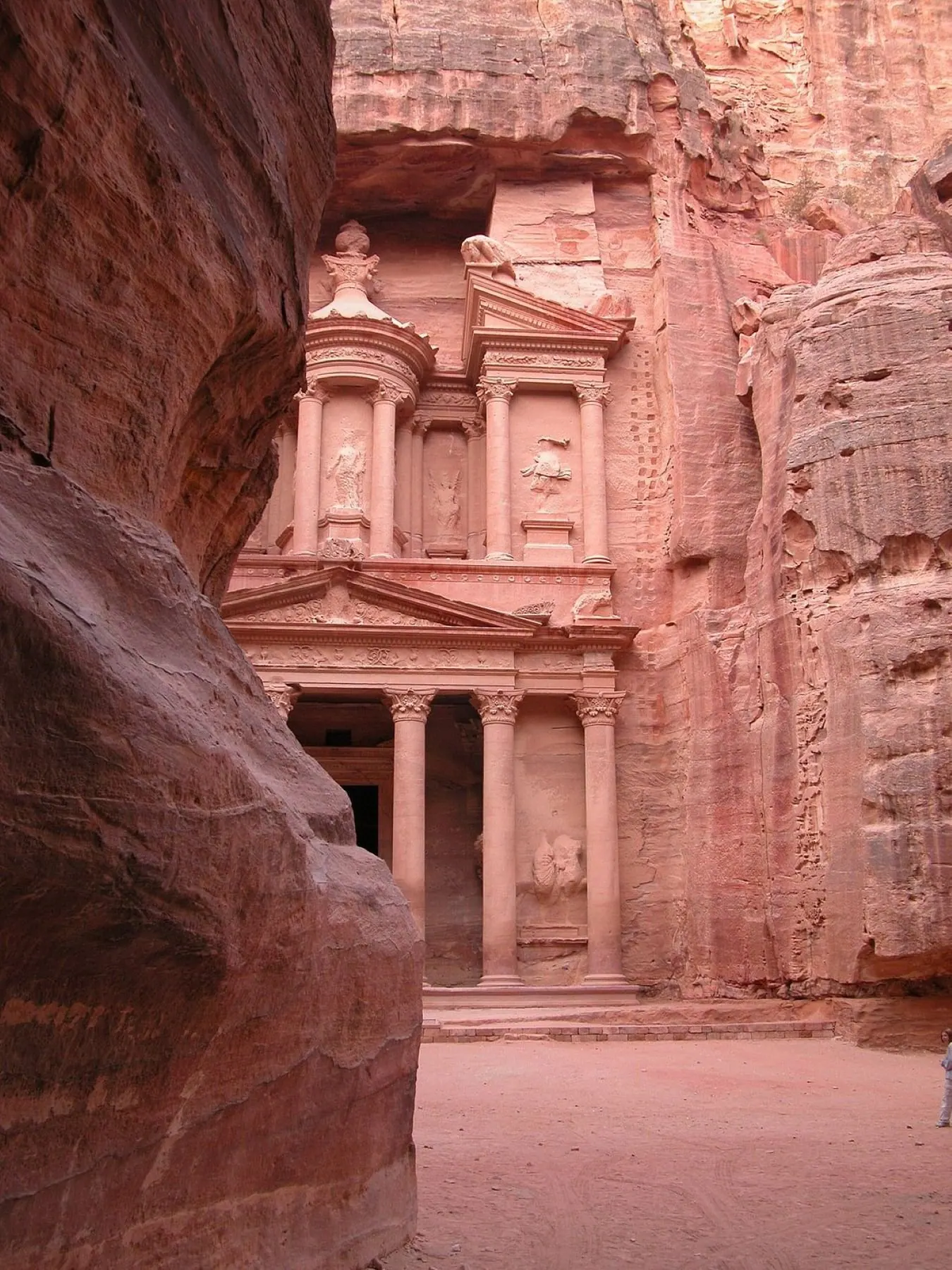
The Nabataeans were remarkable adapters. They absorbed Greek and Roman architectural language — pediments, columns, cornices — and applied it to a rock-cut tradition that was entirely their own. The Treasury is the clearest example: a Hellenistic facade carved out of a cliff face, with no Greek precedent for the technique at all.
The Nabataean kingdom at a glance
| Peak population | Roughly 20,000 in the city |
| Wealth source | Caravan trade in incense & spices |
| Language | Nabataean Aramaic; later Greek & Latin |
| Religion | Polytheist; gods carved as betyls (stone blocks) |
| Roman annexation | AD 106 — became Arabia Petraea |
| Great earthquake | AD 363 — a turning point in decline |
The Roman century
Annexation, not destruction
A common misconception is that Rome conquered Petra by force. In fact, when the Roman emperor Trajan annexed the Nabataean kingdom in AD 106, he did so largely peacefully — the kingdom became the Roman province of Arabia Petraea, and Petra remained an important city. The Romans paved the colonnaded street, built or expanded the Great Temple complex, and integrated Petra into the provincial road network.
What changed was the trade. As Roman shipping took over the movement of goods across the Red Sea, the overland caravan routes that had made the Nabataeans wealthy slowly lost their purpose. Petra’s economy began a long, quiet decline long before any catastrophe struck.
The earthquake of AD 363
On 19 May AD 363 a major earthquake struck the region, damaging much of the eastern Mediterranean. In Petra it toppled the colonnaded street, damaged the Great Temple and Qasr al-Bint, and broke the water system in places. The city never fully recovered its old scale. A smaller Christian community continued to live among the ruins for centuries — you can still see crosses carved into some of the tombs — but Petra’s golden age was over.
A second severe earthquake in AD 551 accelerated the abandonment. By the time the Crusaders built a small fort here in the 12th century, Petra was already largely a memory, and after they left it slipped out of written history entirely.
Rediscovery
Lost, then found again
For nearly six centuries Petra was known to the West only through a few classical references. That changed in 1812, when a Swiss explorer, Johann Ludwig Burckhardt, disguised himself as an Arab scholar and persuaded a local guide to lead him to a ‘treasure’ hidden in a canyon near Wadi Musa. He recognised what he saw, made notes, and could not resist trying to steal a piece of a statue — which got him hurried out of the site. His account, published a few years later, reintroduced Petra to the world.
What is often missed in that story is that Petra was never truly lost to the people of the region. The Bedouin of the area, the Bdoul, lived in and around the tombs for generations and knew the site intimately. The ‘rediscovery’ was a rediscovery by the outside world — the people of Wadi Musa had been here all along.
In 1985 Petra was inscribed as a UNESCO World Heritage Site, and in 2007 it was named one of the New Seven Wonders of the World. Excavation continues every season, and what we know about the Nabataeans is still being rewritten — much of what you will read on these pages reflects work that is genuinely ongoing.
Keep exploring Petra
- Petra Archaeology — How the city was laid out — the colonnaded street, Great Temple, Qasr al-Bint and the tombs.
- The Nabataean Water System — The cisterns, channels and dams that turned a desert valley into a capital.
- The Treasury — Why the Nabataeans carved their most famous facade and what it was really for.
- The Siq — The geological entrance the Nabataeans turned into a processional route.
See Petra through local eyes
Tell us your dates and travel style and we will craft a private Petra journey — with a local team who knows the city’s quiet corners and a licensed guide on request.
Related tours
Full Day · about 6 hours
Petra Back Trail — Monastery Route Private Hiking Tour
From$255 per group (up to 15)View more & Book now