The problem
A capital with almost no water
Petra’s basin is ringed by mountains that channel winter rain into violent flash floods through narrow wadis — including the Siq itself. For most of the year, however, there is almost no surface water. A city the size Petra became cannot survive on springs alone, and the Nabataeans, as former desert caravan traders, knew this better than anyone.
Their solution was to treat water as something to be captured, controlled and moved with great care. Every drop of rain that fell on the basin was a resource; every flash flood was a threat to be diverted. The result was a network of cisterns, channels, dams and pipelines that is now recognised as one of the great engineering achievements of the ancient world.
The components
How the system worked
Cisterns
All over the Petra basin, the Nabataeans cut cisterns into the rock — waterproofed chambers that stored runoff through the long dry season. Many are invisible to the casual visitor because they are simply openings in the ground or under facades, but there are hundreds of them. A single large cistern could hold enough water to supply a neighbourhood for months.
Channels and ceramic pipes
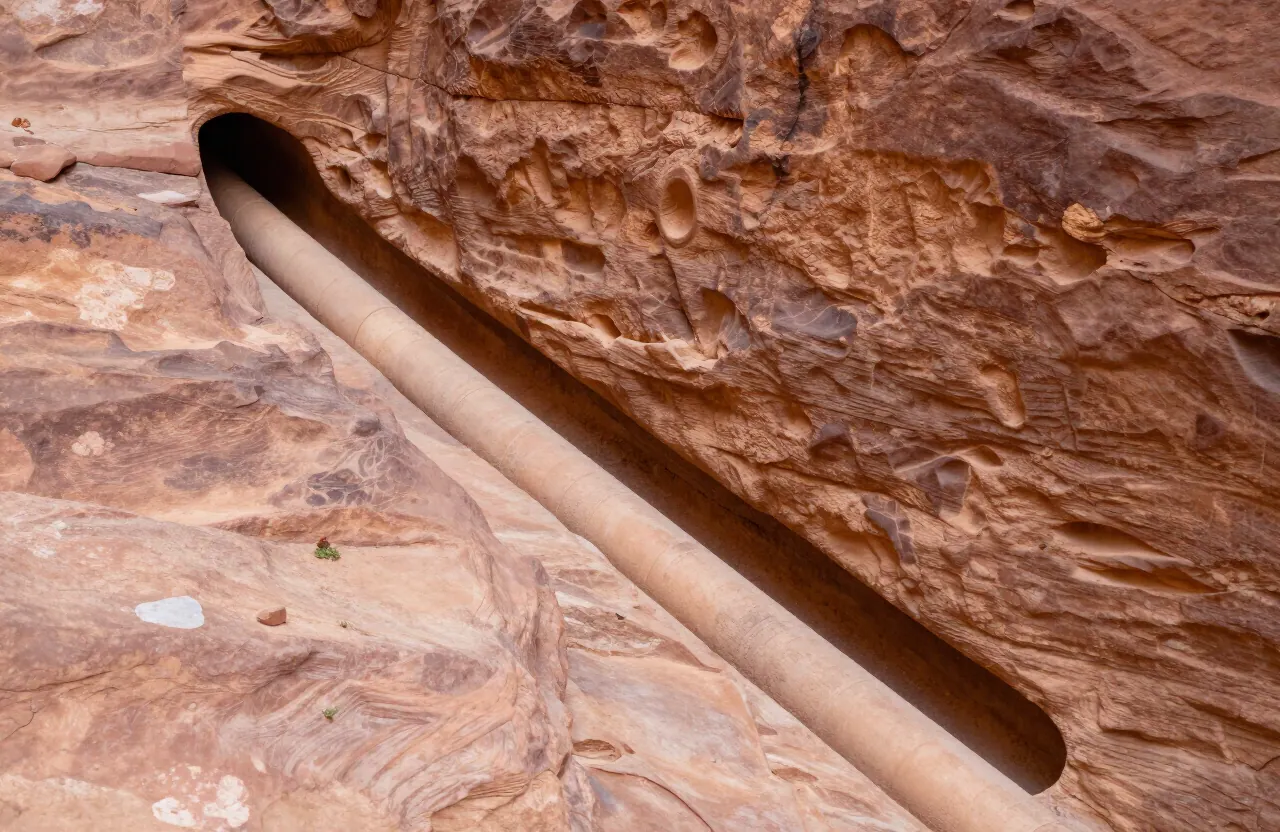
Open channels carved along cliff faces and into the Siq walls carried water from springs and cisterns to where it was needed. Where pressure or cleanliness mattered, the Nabataeans used fired ceramic pipes, fitted section to section and sealed — an early form of pressurised plumbing. You can still see the grooves where pipes ran along the Siq walls.
Dams and flood control
To tame the flash floods, the Nabataeans built a series of dams across the wadis feeding the city centre. The most impressive is the dam at the entrance to the Siq, which was designed to block floodwater from roaring down the gorge and instead divert it through a tunnel cut through the rock into a side wadi. That tunnel — the Siq al-Mudhlim — is still there. Without it, the Siq would have been destroyed by floods centuries ago.
Distribution
Within the city, water was channelled to public fountains, bathhouses (the Great Temple complex included one), gardens and the homes of the wealthy. The recent discovery of a formal garden and pool complex near the Great Temple shows that the Nabataeans had enough surplus water to spend it on display — the ultimate statement of engineering confidence in a desert capital.
The water system at a glance
| Annual rainfall | Only ~150 mm — a desert climate |
| Population served | Up to ~20,000 at peak |
| Cisterns | Hundreds cut into the rock basin |
| Siq dam | Diverted floods via the Siq al-Mudhlim tunnel |
| Pipes | Fired ceramic, fitted & sealed |
| Luxury use | A garden & pool complex near the Great Temple |
Seeing it today
Where to spot the evidence
Once you start looking, the water system is everywhere. In the Siq, watch the left wall for the carved channel and the pipe grooves. Near the entrance, look for the dam and the mouth of the diversion tunnel. Around the Royal Tombs and the colonnaded street, you will see cistern openings and the remains of fountain niches. The Great Temple excavations have uncovered parts of the piped distribution network.
Understanding the water system changes how you read the whole site. The carved facades are spectacular, but they were only possible because the Nabataeans first solved the problem of living here. When you walk the Siq, you are walking through an engineered entrance as much as a geological one — and that is the real secret of Petra.
One practical note: the same flash floods the Nabataeans engineered around can still occur today, occasionally closing the Siq during winter storms. It is rare, but it is why we recommend checking conditions on the day and never entering the Siq during heavy rain. See our travel tips for seasonal advice.
See Petra through local eyes
Tell us your dates and travel style and we will craft a private Petra journey — with a local team who knows the city’s quiet corners and a licensed guide on request.
Related tours
Full Day · about 6 hours
Petra Back Trail — Monastery Route Private Hiking Tour
From$255 per group (up to 15)View more & Book now