What it is
Bigger, higher, and quieter than the Treasury
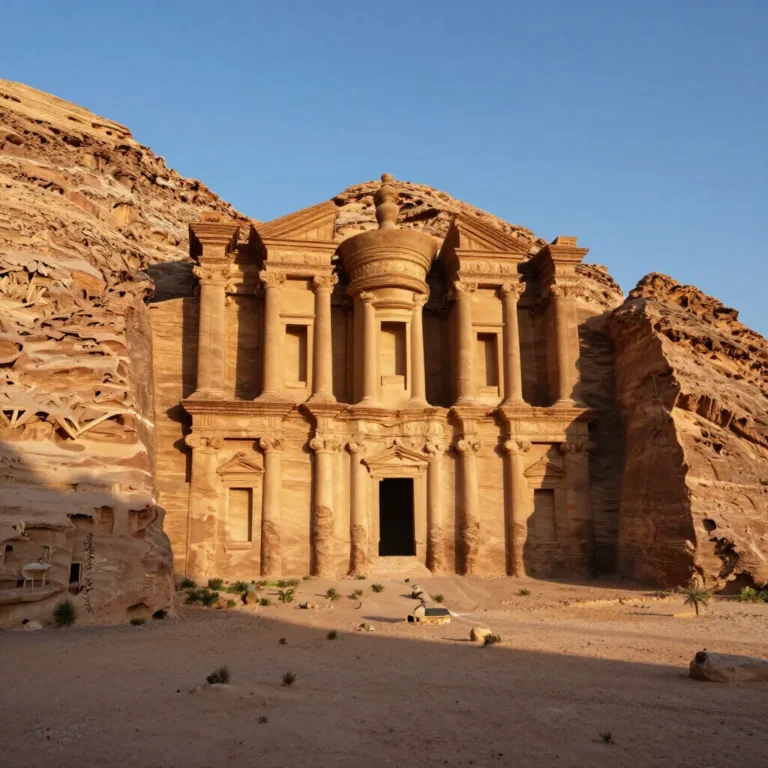
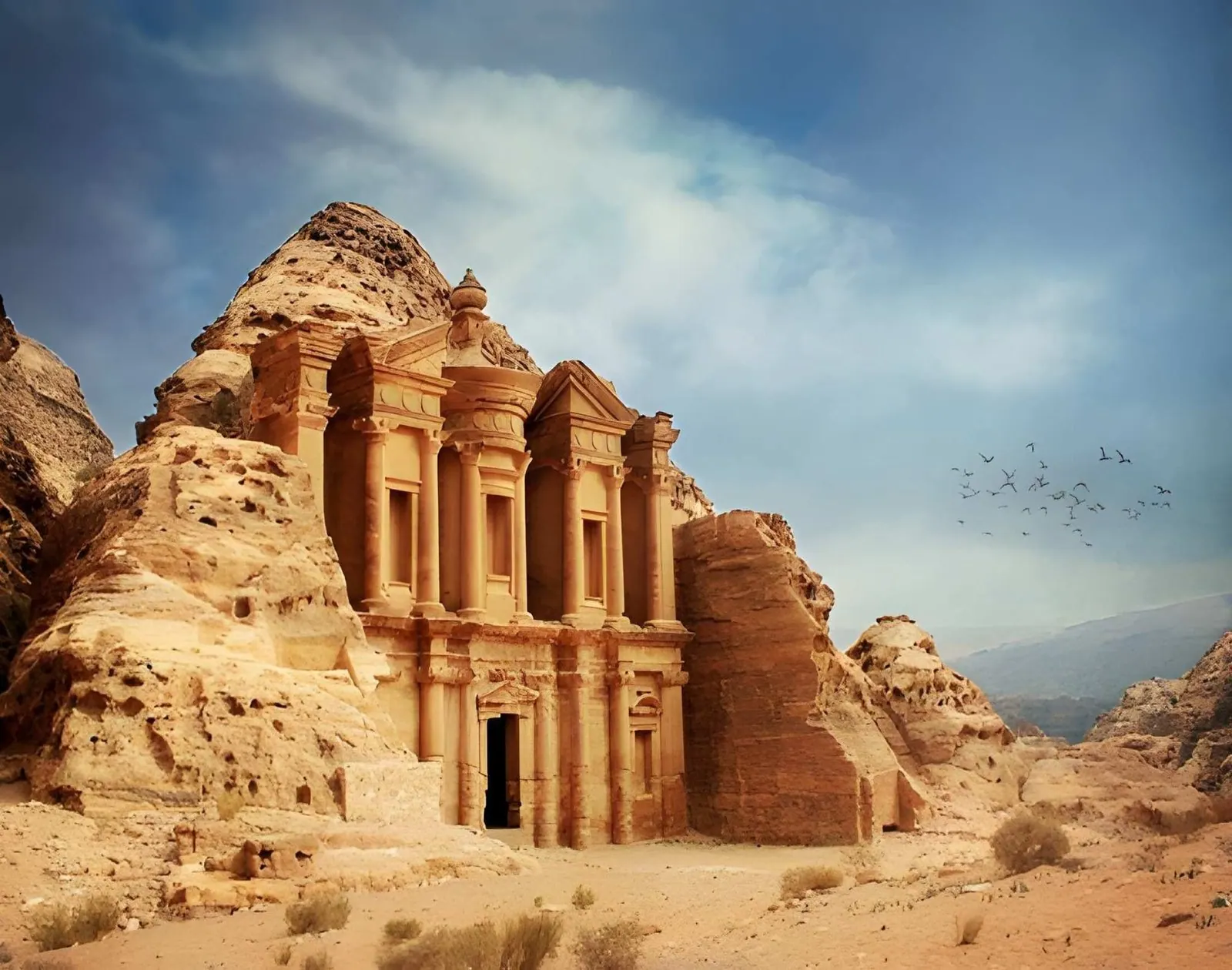
Ad-Deir — ‘the Monastery’ — was carved in the mid-first century BC. Despite the name, it was not a monastery in its original purpose; like the Treasury it was a Nabataean tomb, and a grand one, built for a high-ranking figure whose identity is not certain. It later became a Christian place of worship — hence the crosses carved inside and the name that stuck — during the Byzantine period when a small monastic community used the site.
The facade is around 48 metres high and 47 wide, making it noticeably larger than the Treasury. Its style is simpler and heavier, with a single massive doorway and a plain urn on top, which is part of why it is so striking: it has the weight and presence of something carved to impress at a distance, because anyone approaching it was meant to see it from far below.
The climb
Two ways up
The main steps (the classic route)
The standard route leaves the main trail near the Royal Tombs and climbs the northern slope via roughly 800 rock-cut steps, winding up past the Basin rest area. It takes about 45 minutes to an hour of steady climbing for a reasonably fit walker, longer with rest stops. The steps are uneven and exposed to the sun for much of the way, so early morning is strongly preferable. There are a few small cave cafes along the way selling tea, water and juice — useful rest points, not just refreshment.
The Back Trail (Wadi al-Khayl)
There is a second, longer and far quieter route that approaches the Monastery from the back of the site through Wadi al-Khayl. It is gentler in gradient, much less crowded, and passes through open desert scenery that most visitors never see. It takes longer overall but is easier on the knees. We describe it in full on the Back Trail page — for many of our travelers it is the better way up.
The Monastery at a glance
| Height of facade | About 48 metres |
| Steps (main route) | Roughly 800 rock-cut steps |
| Climb time | 45–60 min up (main route) |
| Difficulty | Moderate–strenuous; steady uphill |
| Built | Mid-1st century BC |
| Best light | Late afternoon on the facade |
At the top
What you get for the climb
The first thing is the facade itself, which in person is even more imposing than in photographs — the doorway alone is several storeys tall. Because far fewer visitors make the climb, you can usually stand in front of it in relative peace, something that is almost never true at the Treasury.
The second thing is the view. A short walk above the Monastery, a viewpoint (often marked by a small cafe) looks out over the entire Wadi Araba and, on a clear day, south toward the horizon of the Negev and the Hejaz. It is one of the great panoramas of Jordan. There are also smaller carved tombs and niches scattered around the summit that almost nobody visits.
Allow time to come down. The descent is easier on the lungs but harder on the knees, and it takes almost as long as the climb. Build that into your day — see our two-day plan for how to pace it without exhausting yourself.
Is the climb right for you?
Alternatives if it is not
The Monastery climb is genuinely strenuous in heat, and it is not the right choice for everyone. If you have older travelers, very young children, or anyone with knee, heart or mobility issues in your group, you can still see the Monastery: donkeys carry visitors up the steps for a fee (negotiate and agree the price in advance), and the Back Trail offers a gentler gradient. There is no shame in choosing either — the view is the same at the top.
For fit walkers and hikers, though, the Monastery is the highlight of Petra. It is the moment the site stops being a single famous facade and becomes a whole mountain city. Pair it with the High Place of Sacrifice on a second day and you will have seen the Petra that most visitors miss entirely.
Climb it with a local guide (on request)
A guide who knows the steps and the quieter Back Trail makes the Monastery climb far more rewarding. These private tours cover it:
See Petra through local eyes
Tell us your dates and travel style and we will craft a private Petra journey — with a local team who knows the city’s quiet corners and a licensed guide on request.
Related tours
Full Day · about 6 hours
Petra Back Trail — Monastery Route Private Hiking Tour
From$255 per group (up to 15)View more & Book now